
There is a particular kind of silence on a trading floor when a number that was supposed to be impossible shows up on the screen anyway. On Tuesday, May 26, that number was thirteen digits long. Micron Technology, the Boise, Idaho memory-chip maker that for forty years lived and died by the brutal up-and-down rhythm of the DRAM cycle, closed the day worth more than one trillion dollars for the first time in its history.
The stock jumped about 19% in a single session. The trigger was a research note from UBS that did something analysts almost never do, which is nearly triple a price target in one move, lifting it from $535 to $1,625 a share. By the close, Micron had become the thirteenth most valuable public company on Earth, sitting at roughly $1.06 trillion. Over the previous twelve months the shares were up around 850%. To put that in plain terms, a person who had put $10,000 into Micron a year earlier was looking at about $95,000.
What makes the moment worth slowing down for is not only the size of the number. It is the speed. Micron took just 48 days to climb from a $500 billion company to a trillion-dollar one. Companies are not supposed to double in seven weeks. And it is the unlikeliness of the messenger, because for most of its life Micron was the stock you traded, not the stock you held. It was famous for boom-and-bust, for gluts and shortages, for being the cyclical cousin at the semiconductor family dinner while Nvidia and TSMC got the headlines.
So how did the cousin end up worth a trillion dollars? The short answer is artificial intelligence, and a kind of memory chip most people have never heard of. The longer answer runs through the life of a man named Sanjay Mehrotra, who was turned away from the United States three times before he was old enough to vote.
01The Number Behind The Number
Why a sleepy memory company suddenly matters
Every AI model you have heard of has a quiet bottleneck, and it is not the one most people assume. The graphics processors get all the attention. But a GPU is useless if it cannot be fed data fast enough, and the thing that feeds it is high-bandwidth memory, known in the trade as HBM. Think of the GPU as a chef who can chop faster than any human alive. HBM is the line of prep cooks sliding ingredients within arm's reach. Without enough of them, the world's fastest chef just stands there waiting.
For 2026, Micron's entire HBM supply is sold out. Not "mostly spoken for" but contractually committed under binding agreements, with price and volume locked in. That includes HBM4, the newest generation, which Micron is shipping in volume for Nvidia's next-generation Vera Rubin platform. The technical sheet is genuinely impressive: a 36-gigabyte stack, a 2,048-pin interface, more than 2.8 terabytes per second of bandwidth per stack, which is more than double the previous generation. For an investor, though, the relevant sentence is simpler. The company has effectively pre-sold its most profitable product for a year, which turns a famously unpredictable business into something that looks, at least for now, almost like an annuity.
That is the shift that moved the stock. When a memory company stops behaving like a casino and starts behaving like a toll road, the market reprices it. Hard.
02A Boy In Kanpur
Where the trillion-dollar story actually begins
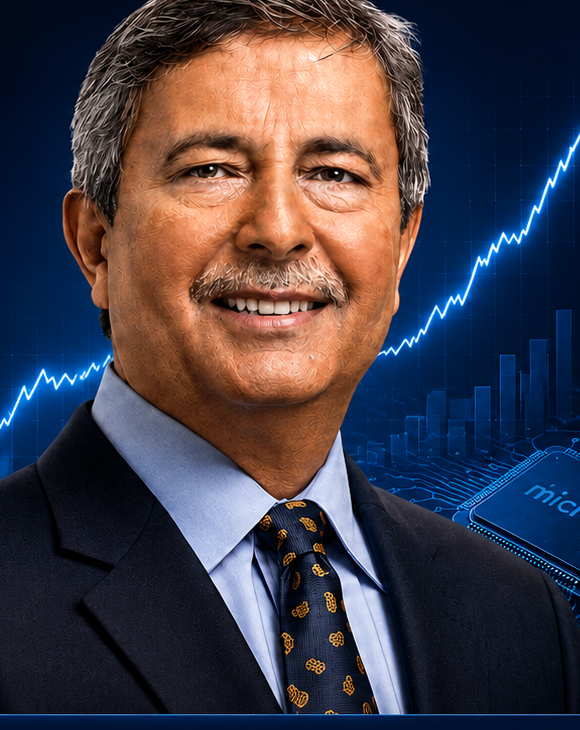
Sanjay Mehrotra was born in 1958 in Kanpur, an industrial city on the Ganges better known for leather tanneries than for silicon. He was the youngest of four children. His father worked as a liaison officer in the cotton trade, and when Sanjay was ten the family moved to New Delhi. The boy who would one day hold more than seventy patents was, by every account, the kind of kid who took things apart to see what was inside, drawn early to math and science. He landed a spot at Sardar Patel Vidyalaya, one of Delhi's strongest schools.
His father had a specific dream, and it was not a small one. He wanted his son educated in America. That ambition collided almost immediately with bureaucracy. American universities at the time wanted twelve years of schooling, and Sanjay's path did not line up cleanly. So he enrolled at the Birla Institute of Technology and Science in Pilani, the famous BITS, and reapplied to the United States after his second year. This time the University of California at Berkeley said yes.
The acceptance, it turned out, was the easy part.
His American visa was denied. Then it was denied again. Then a third time. He was not yet eighteen years old.
The official problem was his age. The consulate would not issue a student visa to a minor. Three times the family went, three times they were turned away. What happened next is the detail that tells you everything about where Sanjay's drive came from, because it did not come only from him. His father refused to accept the answer. He went to the embassy himself, secured a conversation, and spent roughly twenty minutes making the case for his son. By the end of it, the visa was granted. At eighteen, Sanjay Mehrotra boarded a plane and transferred from BITS Pilani to Berkeley, where he earned both his bachelor's and master's degrees in electrical engineering and computer science.
The immigrant footnote that became the headline
When Sanjay co-founded SanDisk in 1988, all three founders were immigrants. Eli Harari came from Israel. Jack Yuan came from Taiwan. Sanjay came from India.
It is a small fact that quietly reframes the trillion-dollar valuation. The technology behind much of modern flash memory and a sizable slice of the AI hardware stack was built by people who, at one point or another, had to convince a stranger at a consulate to let them in.
03The Forty-Year Apprenticeship
SanDisk, the long climb, and a $16 billion exit
Overnight success in semiconductors does not exist, and Sanjay's resume is the proof. Before he was a chief executive he was an engineer, and he stayed one for a long time. He worked at Intel. He worked at SEEQ Technology and at Integrated Device Technology. He learned the unglamorous craft of memory from the inside out, the part of the industry where a single design flaw can erase a year of work and where the difference between profit and ruin is measured in nanometers.
In 1988 he co-founded SanDisk, and over the decades that followed he helped turn flash memory from a curiosity into one of the most ubiquitous components in human life. The chip in your phone, your camera, your laptop, your car: a great deal of that lineage traces back to work Sanjay and his colleagues did. He holds more than seventy patents, several of them foundational to high-capacity flash. He became SanDisk's president and chief executive in 2011, and in 2016 he steered the company into a roughly $16 billion acquisition by Western Digital. That is the sort of outcome most founders would happily retire on.
He did not retire.
04Boise Calls
Taking over Micron at the bottom of the cycle
In 2017, Sanjay joined Micron as chief executive, and the timing was telling. Micron was respected for its engineering but treated by investors as a perennial cyclical, a stock that soared in shortages and cratered in gluts. The job was less about invention and more about discipline: choosing where to spend tens of billions in capital, when to build, when to hold, and which technologies to chase years before the demand arrived.
The results stacked up steadily, well before AI made it obvious. Under his watch Micron climbed 45 spots on the Fortune 500 and pushed past $30 billion in revenue. In 2022 he was inducted into the National Academy of Engineering, one of the highest honors in the field, recognition not for a stock chart but for a body of technical work spanning four decades. Today his own net worth sits north of $1.2 billion, much of it in the roughly one million Micron shares he holds, a stake that has obviously had a very good year.
"What got us here won't get us there." Sanjay Mehrotra, opening Micron Insight 2019
That line, delivered years before the trillion-dollar headline, reads now like a thesis statement. The bet that turned Micron from a cyclical trade into the thirteenth most valuable company in the world was placed long before the market was ready to reward it. By the time HBM became the most fought-over product in technology, Micron had already done the hard, expensive, patient work of being ready to make it.
How he changed the game at Micron
He refused to let memory stay a commodity. The old Micron sold interchangeable chips into a price war it could not control. Sanjay pushed the company up the value chain toward specialized, high-margin products, above all high-bandwidth memory, where being best matters more than being cheapest.
He spent through the downturns instead of flinching. Memory companies usually slash capital spending the moment prices fall. Sanjay kept investing in research and advanced packaging through the lean years, so the capacity and the know-how were already in place when AI demand arrived.
He turned a casino into a contract business. Locking in HBM supply through binding, multi-year customer agreements, with billions in deposits, replaced the boom-and-bust guessing game with visible, committed revenue. That single shift is what let the market reprice Micron from a cyclical trade to a trillion-dollar compounder.
He led with engineering credibility, not just spreadsheets. Seventy-plus patents and a seat in the National Academy of Engineering meant the bet on HBM4 for Nvidia was made by someone who understood the physics, not only the finance.
05The Long Road, In Brief
From a thrice-denied visa to a trillion-dollar close
- 1958Born in Kanpur, India, the youngest of four. The family later moves to New Delhi.
- 1970sAccepted to UC Berkeley, then denied a US visa three times for being under eighteen. His father intervenes at the embassy and the visa is granted.
- 1980sEarns BS and MS degrees in electrical engineering and computer science at Berkeley. Cuts his teeth at Intel, SEEQ, and Integrated Device Technology.
- 1988Co-founds SanDisk with two fellow immigrants, Eli Harari and Jack Yuan.
- 2011Becomes president and CEO of SanDisk.
- 2016Sells SanDisk to Western Digital for roughly $16 billion.
- 2017Takes over as CEO of Micron Technology in Boise, Idaho.
- 2022Inducted into the National Academy of Engineering. Holds 70-plus patents.
- May 2026Micron sells out its 2026 HBM supply, ships HBM4 for Nvidia, and on May 26 closes above $1 trillion, up about 850% in a year.
- Jun 2026Fiscal Q3 lands a record $41.5 billion in revenue and $25.11 adjusted EPS, with HBM booked through 2027 and Q4 guided to a record $50 billion.
06The Numbers Land: Q3 FY26
June 24, 2026 · The quarter that backed up the hype
For weeks the trillion-dollar valuation rested on a promise, which is that the demand was real and the contracts would hold. On June 24, Micron put the receipts on the table. Fiscal third-quarter revenue came in at $41.46 billion. To feel how strange that sentence is, line it up against the recent past: Micron did $23.86 billion the prior quarter and just $9.30 billion in the same quarter a year earlier. The business did not grow, it changed phase, the way water does when it hits a boil.
Adjusted earnings landed at $25.11 a share, comfortably ahead of the roughly $20.49 the Street was modeling. Revenue beat estimates by about 16% and earnings by more than 22%. The stock, which you might think had already priced in perfection, jumped close to 15% after the print. Data-center revenue alone was about $25 billion in the quarter, growing roughly 150% as the AI build-out kept pulling memory off Micron's shelves faster than the shelves could be restocked.
The guidance was the louder signal. Micron told investors to expect record fourth-quarter revenue of about $50 billion, gross margin near 86%, and earnings of roughly $31.00 a share. The company also said HBM3E and HBM4 are now fully booked through calendar 2027, with demand stretching into 2028, and that it has stacked up sixteen strategic customer agreements carrying billions in cash deposits and commitments. Free cash flow hit a record in the quarter, with management pointing to more than $30 billion of it in the quarter ahead.
There was one honest note of caution buried in the optimism, and it is worth flagging rather than glossing over. Micron said its Q4 margin outlook reflects a meaningful moderation in the rate of price increases. Translation: prices are still rising, just not as fast. For a company priced for acceleration, the speed of the speed matters, and that single sentence is the kind of detail the next few quarters will be argued over.
07So, Is The Party Over?
What the bulls and the skeptics are both saying
Here is where honesty matters more than enthusiasm. A stock that has risen 850% in a year is, by definition, pricing in a great deal of good news. The bull case is straightforward and, for now, well supported: AI demand has outrun memory supply, Micron's premium product is sold out and locked under contract, HBM4 has a marquee customer in Nvidia, and Wall Street has scrambled to raise targets into the $800 to $1,625 range. Some analysts are already floating whether a second trillion is possible.
The skeptic's case is just as worth hearing, because memory has humbled confident investors many times. This is still, at its core, a commodity business, and commodity businesses eventually attract competing supply. Samsung and SK Hynix are not standing still. The contracts that look like an annuity today cover 2026, not forever. And valuations built on the assumption that a cycle has been permanently tamed have a long history of meeting the cycle again. None of that means the run is wrong. It means the run is now expensive, and expensive stocks leave less room for disappointment.
For what it is worth, this is information, not advice. Anyone weighing Micron should sit with both stories, because the truth of where the shares go next lives somewhere in the tension between them, and no headline, including this one, can settle it for you.
What the headline can do is point at the quieter truth underneath the number. A trillion dollars is an abstraction. The concrete part is a man who took things apart as a boy in Kanpur, who was told no three times at a consulate window, who spent forty years learning an unforgiving craft, and who then spent nearly a decade preparing a sleepy company for a moment most of the market could not yet see. The valuation is new. The work that earned it is not.