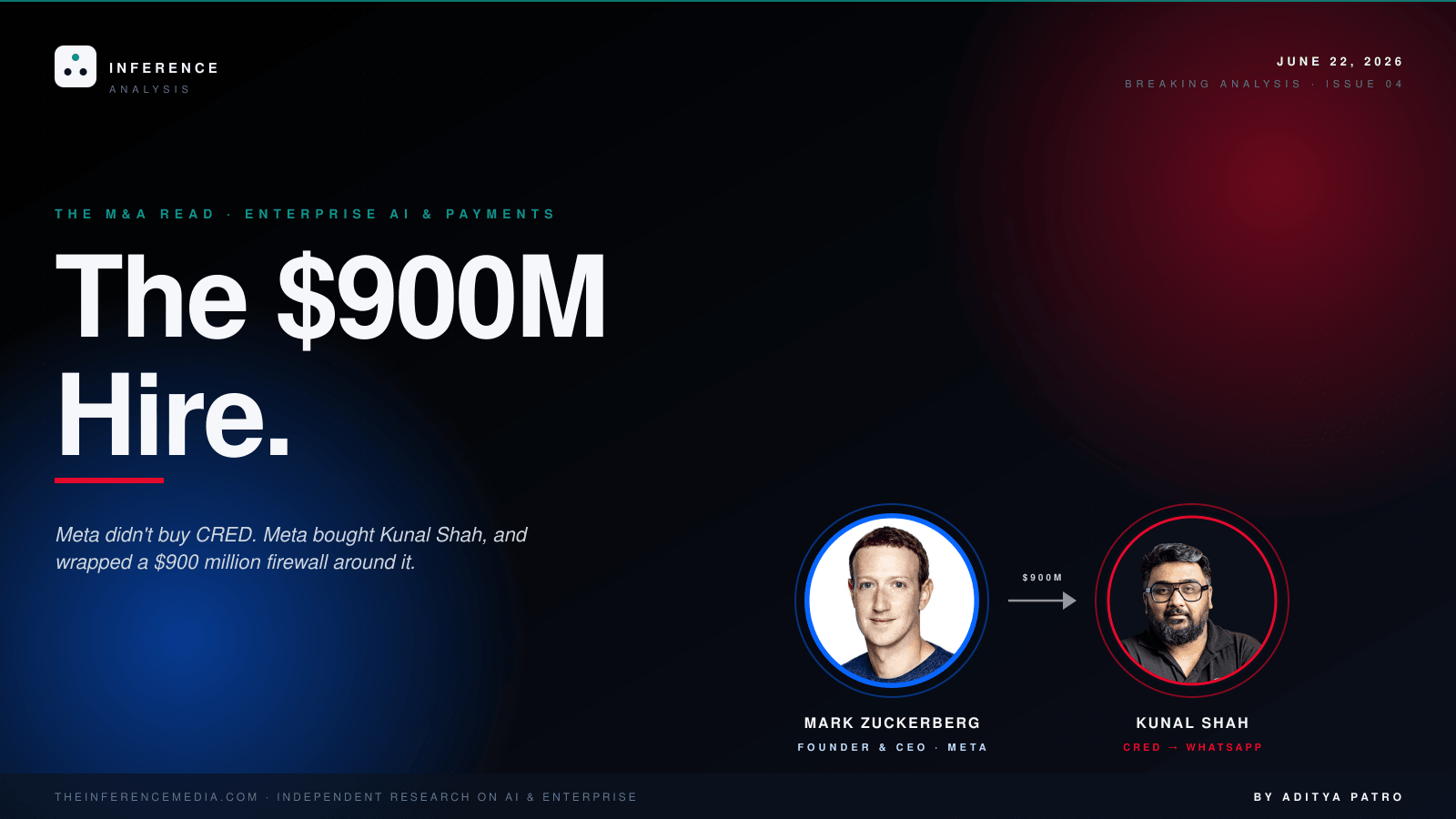
The headline that ran on Bloomberg, BusinessToday and a dozen Indian business outlets this morning is simple, and almost everywhere it is wrong. Meta has not acquired CRED. Meta has not even taken a controlling position in CRED. What Meta has done is buy approximately twenty per cent of a Bengaluru fintech for nine hundred million dollars, declined a board seat, declined access to customer data, and persuaded the company's founder to walk across the Pacific to run WhatsApp. The deal is engineered, deliberately and beautifully, to look like an acquisition and behave like a hire.
The structure is the story. Everything you need to understand about Meta's next five years in India, and about why Will Cathcart is being moved out of WhatsApp, sits inside the three numbers that nobody is putting on the front page.
The deal, in the numbers nobody is reading
- Headline ticket
- $900M from Meta into CRED's Series H, a mix of primary and secondary share purchases.
- Post-money valuation
- ~$4.5B — a 30% discount to CRED's 2022 peak of $6.4B, a 28% step-up from its 2025 downround at $3.5B.
- Meta's economic stake
- ~20% minority. No board seat. No customer data access. No operational control.
- The actual prize
- Kunal Shah — stepping down as CRED CEO, joining Meta's global leadership, taking over WhatsApp from Will Cathcart.
- The quieter trade
- Will Cathcart — exiting WhatsApp leadership, moving to a new role focused on Meta's AI initiatives.
01The structure is the firewall
Take a normal Silicon Valley acquisition apart and you find the same set of bones every time. A majority stake, a board seat, integrated operations inside twelve to eighteen months, a unified data layer, a single accountable P&L. The acquirer wants control because control is what justifies the premium. None of that is present here. Meta walked away from a board seat and walked away from customer data on a $900 million cheque. In Menlo Park, that costs careers. In Bengaluru, with the Reserve Bank of India and the National Payments Corporation watching, it buys you the right to do the deal at all.
The Indian payments regulator has, for five years, played one consistent move: keep foreign-owned consumer payment infrastructure on a leash. WhatsApp Pay was capped at 100 million users for nearly three years before NPCI finally lifted the restriction in late 2024. Walmart-owned PhonePe and Google Pay between them run 85% of UPI volumes, and every regulatory utterance since 2023 has been about reducing that concentration, not deepening it. Into that environment, a full Meta acquisition of CRED was always going to be a non-starter. A minority investment with explicit data and governance firewalls is not just clever structuring. It is the only structure the deal could have taken.
This is the part the morning headlines are missing. Bloomberg's piece calls it an investment "as part of" the WhatsApp appointment. That phrasing flips cause and effect. The $900M is not the price of the strategic stake. The $900M is the price of the hire — a structural mechanism that lets Meta install Shah at WhatsApp without it looking, regulatorily, like Meta took control of an Indian fintech.
02The Will Cathcart pivot nobody is writing about
If the morning's coverage has under-read the structure on the Meta-CRED side, it has almost entirely missed the move on the Cathcart side. Will Cathcart led WhatsApp through its hardest seven years. He was the one who shepherded end-to-end encryption through every regulatory pressure point on three continents. He fought the Indian traceability rules in the Bombay High Court. He absorbed the cost of Pegasus, of the Brazilian shutdowns, of the German rulings on metadata. He is not being moved sideways. He is being moved to where Meta's next decade lives.
The press release calls Cathcart's new posting "AI initiatives." What that almost certainly means, given the agent strategy Mark Zuckerberg outlined at Meta Connect last September and the rumoured restructuring of the AI Foundation team in Q1 of this year, is that Cathcart is taking over a piece of the consumer agent stack. The same person who built WhatsApp's encryption defence is now building the regulatory and trust architecture for Meta AI agents at scale. Nobody else inside Meta has done that work in production.
Read it that way and the trade looks different. Cathcart inherits the next decade. Shah inherits the existing product. The press release stages a leadership rotation, and underneath the staging, Meta has moved its most regulatorily fluent operator from a defensive posture (defending WhatsApp) to an offensive posture (deploying AI agents into the same regulated geographies). That is the larger reorganisation. The CRED deal is the surface.
03What Shah actually inherits
WhatsApp has, on paper, the biggest user base of any consumer product Meta owns. It has, in practice, the smallest revenue per user of any consumer product Meta owns. The disparity is the job description.
The public framing of Shah's mandate is "monetisation" — advertising, subscriptions, the kind of work Antonio Lucio talked about on the WhatsApp Business side at the developer conference. That framing is correct as far as it goes. It is also under-stated. Shah is not being brought in to optimise an existing monetisation playbook. He is being brought in because Meta has run that playbook for six years and it has not worked at scale anywhere except in WhatsApp Business inside Latin America and parts of Southeast Asia.
The places where WhatsApp monetises today look like the places where CRED scaled. Premium consumer surfaces. Aspirational design. A loyalty layer that runs adjacent to payments rather than on top of payments. CRED's defining trick was that it captured a consumer behaviour (paying credit card bills on time) that was margin-negative for everyone else, and built a premium-positioned media and commerce business around the behaviour. WhatsApp's monetisation problem is the same shape. Messaging is a negative-margin commodity. Whatever sits adjacent to messaging — commerce, agents, finance, identity — is where the margin lives.
What Shah brings is a six-year reference for what that looks like when it is actually built. What he is being given is the largest consumer surface on the planet to attempt it again.
Inference take
The biggest risk in Shah's appointment is not Indian regulatory backlash, although that will come. The biggest risk is that the CRED playbook was a 25-million-user playbook executed inside a culturally specific aspirational frame. WhatsApp is 3 billion users. The monetisation models that scaled CRED do not have a single proof point at WhatsApp scale, and the assumption that they will translate is unproven. Shah's first 18 months are about finding out whether they do.
04What CRED loses, and what it quietly gains
The public reading is that CRED has just landed the most attractive late-stage investor in Indian fintech history, recovered most of its lost valuation, and bought a clear path to a public listing. The first two are correct. The third is the conversation worth having.
Miten Sampat, who has run strategy and finance at CRED since 2020, becomes interim CEO with immediate effect. Sampat is widely understood inside the Indian VC community as the operating spine of the company — the one who took CRED's commercial architecture from the rewards-only origin into mutual funds, into bill payments at scale, into the Mint Money product, into the credit card issuance partnerships that pushed annual revenue to $325 million and the first profitable quarter on record. He is not an unknown quantity. He is also, importantly, not Shah.
Shah was the brand. Shah was the voice. Shah was the reason CRED's design and copy and viral campaigns had a coherence that nothing else in the Indian fintech market could match. With Shah at Meta, CRED becomes a more conventional financial-services operator. The numbers may keep climbing — Sampat's track record suggests they will — but the cultural premium that justified the 2022 valuation (and arguably justifies a future IPO at $8B-plus) is the variable nobody is modelling.
What CRED gains, beyond the cheque, is a structural relationship with the largest messaging surface on the planet — without surrendering control of it. The deal terms make plain that customer data is not shared, but commercial partnership lanes will open in ways they would not have if Meta had stayed at arm's length. CRED's distribution surface just got a billion users wide, even if its corporate boundary stayed the same.
05The five-year read
Strip the press release language away and the picture is this. Meta has tried to crack Indian payments natively for seven years and failed. It has hired a regional founder it could not hire any other way (because Shah would not have left CRED without a structural mechanism that protects what he built). It has moved its most regulatorily fluent operator to its next-decade product. It has done all of this without taking a board seat at the Indian fintech whose founder it just installed at the top of a $400-billion-revenue product. The structure is engineered. The narrative is engineered. The thing that comes next is what to watch.
Shah's first six months are a monetisation diagnostic, not a launch
Expect public silence on big-bet announcements until Q2 2027 at the earliest. The first six months are about understanding which monetisation primitives travel from CRED to WhatsApp, and which die at scale. The launches come in 2027, not 2026.
The agent layer is the actual product, not advertising
Watch Cathcart's AI portfolio more carefully than Shah's WhatsApp roadmap. The combined trajectory is WhatsApp-as-agent-substrate, with the monetisation flowing through agentic commerce rather than display advertising. The advertising framing is the public version of a deeper consumer-agent strategy.
CRED IPO timing slips, then re-anchors
The earlier IPO chatter was Q4 2026 / Q1 2027. With Shah at Meta, expect a six-to-nine month slip while Sampat establishes operating credibility independent of the founder narrative. The IPO that finally lists is a steadier, less heroic story — and it may price better for it.
The structural firewall gets stress-tested in 18 months
"No board seat, no customer data" reads cleanly today. Eighteen months in, the natural commercial integrations (WhatsApp Pay routing through CRED rails, CRED-issued cards inside WhatsApp commerce, agent-led credit underwriting) will test the firewall. The deal works only if both companies hold the line under pressure. The first time they don't, RBI and NPCI are watching.
The talent market just repriced
Every other India-scaled founder under forty just watched Meta pay $900 million to acquire one. The signal travels. The next ten regional fintech founders who get courted by Big Tech will price themselves against this benchmark, and the cost of acquiring regional operating expertise inside the next-decade products at Meta, Google, Apple and Amazon just went up by an order of magnitude.
06What this is, finally
It is tempting to read the deal as a triumph of Indian consumer-tech ambition. A founder built a company worth $6 billion, sold a fifth of it for nine hundred million, and walked into one of the most powerful product seats in global technology. That reading is correct. It is also the smaller of the two readings available.
The larger reading is that Meta, the largest consumer technology company in the world, looked at the Indian payments market and concluded that no amount of capital deployed from California could fix the gap. The fix had to be installed from inside the geography. The $900 million is the cost of admitting that. Everything else — the valuation, the press release, the magazine covers Shah will be on by the end of the week — is consequence.
What we are watching is not an acquisition. It is a confession of strategic limit, wrapped in a structural firewall, financed at a scale that hides what it really is. Meta did not buy CRED. Meta bought one operator, paid the entry fee for him, and made the rest of the world spend the morning describing the wrapper.
The next eighteen months will tell us whether the operator was worth the entry fee.
- Bloomberg — Meta Taps New WhatsApp Boss as Part of $900 Million Investment
- BusinessToday — WhatsApp gets a new boss
- Quartz — Meta invests $900M in CRED, Kunal Shah to lead WhatsApp
- BW Businessworld — Meta Invests $900 Mn In CRED
- Inc42 — Kunal Shah Leaves CRED For Top Role At WhatsApp
- Storyboard18 — Meta invests $900 million in CRED
- TechCrunch — Amazon, Meta join fight to end Google Pay, PhonePe dominance
Analysis like this, every Tuesday.
The Morning Edition publishes every Tuesday at 7:30 AM. Breaking analysis like this one between. Five minutes to read. One-click unsubscribe.
Subscribe on Substack