The cleanest way to put it is this: the employees who have benefited most from the large language model boom are not evenly distributed across tech. The biggest upside has gone to early- and mid-stage staff at OpenAI and Anthropic, where already huge salaries were layered on top of private equity grants that appreciated at a pace Silicon Valley rarely sees. Google DeepMind and Meta still pay extraordinarily well, but their employee value propositions differ. The upside is more liquid, more diversified, and usually less explosive. xAI appears to sit in the middle as a high-pay, high-intensity frontier lab with strong cash and equity packages but less mature public disclosure around realised employee outcomes. Mistral, by contrast, looks more like the European version of the model, with less extreme headline compensation but a benefits-heavy package and a sovereignty-driven strategic story.
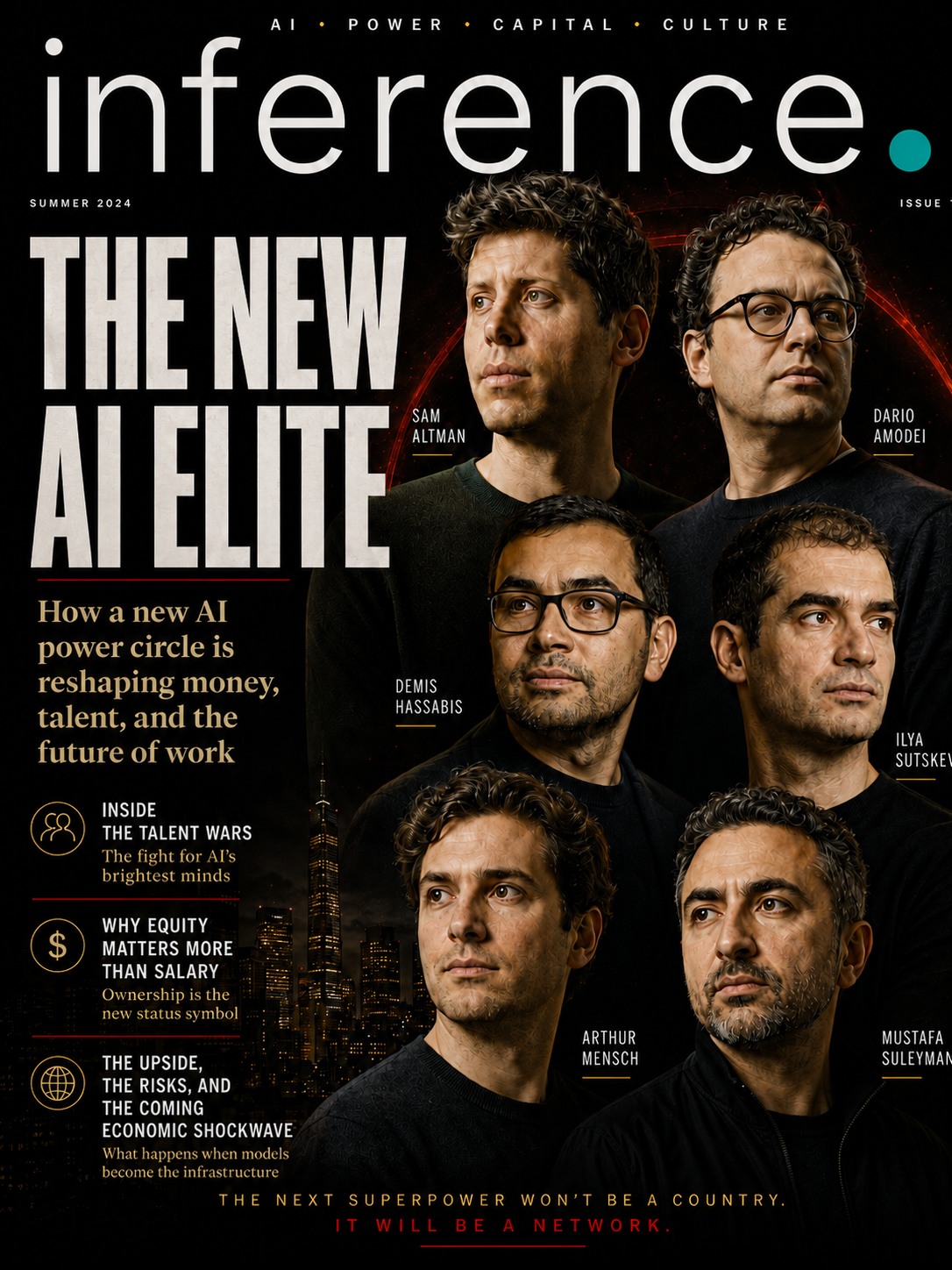
The second big finding is that the so-called LLM cabal is real in structure, even if the word "cabal" is a little theatrical. What exists is a dense, self-reinforcing network of alums, investors, hyperscalers, chip suppliers, and policy forums. Former OpenAI leaders helped create Anthropic, Safe Superintelligence, and Thinking Machines Lab. Former Google DeepMind and Meta researchers founded Mistral. The same companies that compete for talent also co-fund safety forums, share infrastructure dependencies, and circulate star researchers among themselves. It is less like a secret society and more like a power graph with very few degrees of separation.
The third finding is economic. The upside case is real: productivity gains, faster software development, better scientific tooling, and higher wage premiums for people who can work well with AI. The downside is also real: a thinner apprenticeship ladder, pressure on entry-level white-collar work, rising inequality between AI-complementary and AI-substitutable roles, and a growing tendency for firms to chase revenue growth with fewer permanent employees. The most honest macro read right now is not "AI is definitely replacing everyone" or "AI is just another tool." It is that AI is already redistributing bargaining power toward frontier talent, toward capital, and toward workers whose value comes from judgment rather than routine execution.
01How the employee pay-off has looked
A fair comparison needs three lenses: cash compensation, equity upside, and liquidity. It also needs one caveat. Most company-by-company pay data in this space comes from Levels.fyi, which aggregates anonymous and verified salary submissions rather than official company disclosures. That makes the numbers useful and directionally strong, but not perfect apples-to-apples accounting.
| Lab | Median engineer pay | Equity upside lens | Multiple of BLS median |
|---|---|---|---|
| OpenAI | ~$800K US (range $254K–$1.23M) | $852B post-money; $6.6B 2025 tender, some sold $30M each | ~6.0× |
| Anthropic | ~$746K US (senior $563K, lead $841K) | $965B post-money (May 2026), up from $61.5B in March 2025 | ~5.6× |
| xAI | ~$640K US ($240K base + $400K equity) | $230B valuation talks (late 2025); less mature liquidity | ~4.8× |
| Meta | ~$454K US (AI researcher) | Liquid RSUs; reported $100M bonuses to OpenAI staff; $200M+ to Ruoming Pang | ~3.4× |
| Google DeepMind | ~$438K US (AI researcher) | Liquid RSUs; up to $20M/yr for select stars; vesting shortened 4→3 years | ~3.3× |
| Mistral | ~€90K France (range €102K–€142K at common levels) | €11.7B valuation (Sep 2025); ASML largest shareholder | n/a (different market) |
OpenAI is the standout in pure median engineer compensation. Levels.fyi shows a median software engineer package of about $800,000 a year in the United States. For context, the US Bureau of Labour Statistics reports a median software developer wage of $133,080, so OpenAI's reported median is about six times the national median for that occupation. OpenAI's upside story goes beyond annual pay. Reuters and OpenAI's own March 2026 announcement place the company at an $852 billion post-money valuation, and a Wall Street Journal report says more than 600 current and former employees participated in a 2025 share sale totalling $6.6 billion, with some individuals selling as much as $30 million in stock.
Anthropic is very close behind in annual compensation and may now lead in on-paper wealth inflation. Reuters reported Anthropic at a $965 billion post-money valuation in May 2026, up from $380 billion in February 2026 and $61.5 billion in March 2025. That kind of repricing is why secondary-market observers and compensation analysts have described Anthropic as a new millionaire factory. Even if not all of that value is liquid or after-tax, the paper gains for employees who joined before the late-stage funding surge are plainly enormous.
Google DeepMind looks different. On median reported annual comp for AI-builder roles, Levels.fyi shows Google AI researchers at roughly $438,000 in the United States, or a little more than three times the BLS median for computer and information research scientists. That is elite pay by any normal standard, but it is materially below the startup-frontier leaders on median packages. What Google offers instead is a combination of brand, public-market liquidity, global research scale, and infrastructure depth. Reuters also reported that Google DeepMind offered select star researchers packages worth as much as $20 million a year, gave off-cycle equity grants specifically to AI researchers, and in some cases shortened vesting from four years to three. In other words, Google's broad package is safer, but its bid for true superstars has become every bit as aggressive as the frontier startups.
Meta sits just above Google in reported median pay for AI researchers. Levels.fyi shows a median Meta AI researcher package of about $454,000. Like Google, Meta's case is less about everybody getting startup lottery tickets and more about liquid RSUs plus large cash and bonus structures. But Meta has also distorted the top end of the frontier market. Reuters reported Sam Altman's claim that Meta offered OpenAI employees bonuses of $100 million, and Reuters separately reported that Ruoming Pang's package at Meta was worth more than $200 million over several years. Whether every rumour is true is beside the point. The compensation floor is already huge, and the compensation ceiling for top AI talent has diverged from typical big-tech logic.
xAI has emerged as a serious pay contender with a frontier-startup risk profile. Levels.fyi shows a median US software engineer package of about $640,000, with a sample median package on the page showing roughly $240,000 base and $400,000 annualised equity. Reuters reported that xAI was in talks about a $230 billion valuation in late 2025, which gives employees meaningful upside, though not yet the same documented liquidity scale as OpenAI. The combination suggests xAI is paying like a company that knows it must overpay to buy time, speed, and attention in a market where the top few hundred researchers matter disproportionately.
Mistral is the outlier in this group because it is both European and more transparent about being a benefits-heavy employer rather than a pure headline-cash outlier. Levels.fyi reports a median software engineer package in France of about €90,000. Reuters reported Mistral at an €11.7 billion valuation after its September 2025 round, with ASML becoming its largest shareholder. That means the upside is real, but the cash package is nowhere near the US frontier-lab extreme. If OpenAI and Anthropic feel like a market for instant paper aristocracy, Mistral feels more like a strategic nation-building lab with attached equity upside.
The bottom-line ranking
If the question is who created the most wealth for employees already inside the tent: OpenAI and Anthropic. If the question is who offers the safest path to getting rich while preserving liquidity and institutional stability: Google and Meta. If the question is who offers the most asymmetric frontier bet right now: xAI. If the question is who offers a distinctly European package with lower cash extremes and stronger social benefits: Mistral.
02Perks, culture, and the hidden price of the upside
The perks story matters because frontier AI employers are not selling only money. They are selling intensity with a cushion. OpenAI says its benefits include comprehensive health coverage, mental health care, a company retirement plan, a domestic conference budget, 24 weeks of paid leave for birth parents, 20 weeks of paid parental leave, annual learning support, and daily breakfast, lunch, and dinner. Anthropic offers comprehensive insurance, fertility benefits, 22 weeks of paid parental leave, flexible paid time off, retirement matching, equity donation matching, a $500 monthly wellness and time-saver stipend, home office stipends, education support, relocation help, and daily office meals and snacks. Those are not decorative perks. They are the support systems that make extreme work intensity more sustainable for a narrow group of highly sought-after workers.
Meta and Google still look more like the classic big-tech welfare state. Meta's official careers materials advertise paid leave for new parents including adoptive parents, family-planning support covering fertility, adoption and surrogacy assistance, and access to financial planning. Google's own blogs and benefit summaries show expanded parental leave, carers' leave, work-from-home support, extra reset days, free meals in some operations, and unusually broad family-oriented support. In plain English, the older giants still win on breadth, internal mobility, and long-tail support across more life situations.
xAI and Mistral advertise a different kind of bargain. xAI promises competitive cash and equity, full health coverage, fertility support, flexible vacation, visa sponsorship, and retirement savings, but also says plainly that it values "ambitious goals" and "fast execution," prioritises in-person work, and wants people who can move with urgency. Mistral's careers page highlights 100 per cent employer-sponsored family healthcare in covered markets, 20 weeks of paid leave for birthing parents, childcare support, retirement contributions, relocation assistance, meal allowances, transportation support, and fitness subsidies, while also emphasising speed, low ego, and a sleeves-rolled-up culture. These are both attractive packages. They are also signals that competition at the frontier is now organised around speed as much as salary.
There is also a less glamorous side to the upside. Private-company wealth is not the same thing as liquid take-home money. OpenAI's older compensation model used Profit Participation Units, and Levels.fyi's compensation explainer notes that those units historically came with a two-year lock and relied on tender offers for liquidity. Levels.fyi also says that, as of January 2026, OpenAI had shifted new offers from PPUs to RSUs and removed the vesting cliff, which is friendlier to employees but does not erase the fact that realised wealth in private labs still depends on company-controlled liquidity windows, taxes, dilution, and timing. Anthropic and Mistral, meanwhile, still show standard four-year vesting on public compensation pages. Put simply, a lot of people in this sector are rich on paper before they are rich in the bank.
The hardest hidden price, though, is market distortion. Once Google DeepMind is willing to offer certain individuals up to $20 million a year, and once the Meta market starts talking in nine-figure recruiting language, the labour market stops behaving like a normal one.
03What the LLM cabal looks like
If the PayPal Mafia was a founder-generation network that kept seeding new companies and boards, the LLM version is a founder-and-researcher network built atop capital, compute, and policy leverage. Anthropic was founded by former OpenAI employees who left over concerns about direction and safety. Former OpenAI chief scientist Ilya Sutskever co-founded Safe Superintelligence. Former OpenAI CTO Mira Murati founded Thinking Machines Lab, and Reuters reported it launched with around 30 researchers and engineers from competitors, including OpenAI, Meta, and Mistral. Reuters also reported that OpenAI co-founder Andrej Karpathy joined Anthropic in 2026. That means the strongest labs are not just competing with one another. They are recursively creating one another.
Google DeepMind and Meta form the other major trunk of the tree. Reuters reported Mistral was founded by former researchers from Google DeepMind and Meta. Google DeepMind's own careers page emphasises its "full-stack" advantage, from chips to global deployment, which helps explain why so many ambitious researchers either stay there or spin out from it. Meta, for its part, is both a talent source and a talent sink. It has fed founders into the European model race and then returned as one of the market's biggest buyers of elite AI talent. This is one reason the PayPal Mafia comparison works. The same people keep appearing in the next company's founding story, leadership team, or recruiting war.
The power graph gets even tighter when you move up one layer to alliances and backers. Anthropic, Google, Microsoft, and OpenAI jointly launched the Frontier Model Forum, an industry body around frontier-model governance and safety research. Anthropic is backed strategically by Amazon and Alphabet, according to Reuters. Mistral's 2025 round made ASML its largest shareholder and included Nvidia as a notable investor. OpenAI's 2026 financing round, according to OpenAI itself and Reuters, was a historic $122 billion event at an $852 billion valuation. This is why the frontier ecosystem feels clubby even when companies are fighting. The same names recur in talent, money, governance, and infrastructure.
That does not mean the firms are colluding in some cartoonish sense. It means the market has become structurally concentrated. Talent is concentrated because only a small number of people can move the pretraining frontier. Capital is concentrated because the required spending is gigantic. Distribution is concentrated because a handful of firms already dominate cloud platforms, consumer apps, and enterprise channels. And standard-setting is concentrated because the same labs that build the frontier also fund many of the venues where frontier safety language gets shaped. For the broader economy, that kind of concentration matters as much as model quality does.
04How is this likely to hit the economy?
$2.6–4.4T
McKinsey: annual generative AI value across examined use cases
40%
IMF: share of global jobs affected by AI (60% in advanced economies)
14–15%
NBER / QJE: productivity gain in customer support from generative AI
62%
PwC 2026: global wage premium for workers with AI skills
The upside case is the easiest to document. McKinsey has estimated that generative AI could add $2.6 trillion to $4.4 trillion annually across the use cases it examined. The IMF has said AI could affect almost 40 per cent of jobs worldwide, rising to around 60 per cent in advanced economies, with part of that exposure reflecting complementarity rather than simple substitution. In direct workplace evidence, the widely cited NBER and QJE study on customer support found that generative AI raised productivity by about 14 to 15 per cent, with the gains concentrated among less-experienced and lower-skilled workers. The ECB and the European Investment Bank have also reported early evidence that AI adoption can raise productivity without reducing employment in the short run.
The wage story is where the upside becomes uneven. PwC's 2026 AI Jobs Barometer says workers with AI skills command a 62 per cent wage premium globally, and that AI-exposed jobs are splitting into two tracks. In jobs being "professionalised" by AI, wages and growth are rising faster because the technology increases the value of judgment, leadership, and problem framing. The World Bank's 2026 work on digital skills reaches a similar conclusion, finding especially strong wage premiums for GenAI-related skills, including 7 to 9 per cent additional premiums for GenAI development skills in digital-core occupations and 25 to 36 per cent additional premiums for GenAI literacy skills in digitally enhanced roles such as marketing and finance. This is not just a tech-sector story anymore. It is a labour-market repricing story.
The downside case is also already visible. The World Bank reported that following ChatGPT's launch, job postings in occupations with above-median AI substitution scores fell by an average of 12 per cent between late 2022 and June 2025. The IMF's 2026 staff note on new-skill creation says these shifts raise wages and employment on average but also deepen polarisation, with benefits mostly accruing to already advantaged workers. PwC's 2026 barometer also says AI-exposed entry-level jobs are now seven times more likely to require traditionally senior skills such as leadership and people management. That may end up being one of the biggest long-run labour effects. If AI strips routine work out of junior roles, companies may get more output while producing fewer experienced mid-level workers five years later.
That said, collapse narratives still run ahead of the evidence. Reuters, citing ECB work released in June 2026, reported that the aggregate wage and employment impact in the United States has so far been muted, even as high-risk occupations have seen weaker growth and some job loss. The OECD has likewise argued that there is still little evidence of broad AI-driven job destruction, even though 27 per cent of employment in OECD countries is in occupations at the highest risk of automation. The cleanest read is that the labour market has entered a reallocation phase, not a fully realised mass-displacement phase.
The Inference take on the labour math
The market has entered a reallocation phase, not a mass-displacement phase. The transition may still become harsher later, but the current damage is more concentrated than universal. The headline-grabbing question is whether AI replaces everyone. The operationally important question is who in your organisation is AI-complementary, who is AI-substitutable, and what fraction of your hiring pipeline still serves the apprenticeship ladder that produces senior talent five years out. The firms that lose this decade are the ones who optimised for short-run productivity by hollowing out junior tracks.
05Bottom line
If you strip away the hype, the payoff story is surprisingly clear. The people with the best trade in tech over the last two years were not generic software engineers. They were the early employees, researchers, and product builders inside the small set of labs that pushed frontier LLMs into the mainstream. OpenAI and Anthropic created the sharpest employee upside. Google DeepMind and Meta remained incredibly lucrative while offering the stability and liquidity of giant public platforms. xAI is bidding hard to join the first tier. Mistral is building the strongest sovereign-European alternative, though on a different compensation curve.
The PayPal Mafia analogy works, but only up to a point. The old model was a tightly knit founder network. The new one is more industrial. It is a stack made of alums, hyperscaler leverage, chip and cloud dependencies, giant funding rounds, and a handful of governance bodies where the same firms keep showing up. That stack is powerful enough to shape wages, startup formation, standards, and eventually national competitiveness.
For the broader economy, the likely result is not one clean outcome but a split screen. On one side, faster productivity, better tools, stronger scientific leverage, and higher wages for people who know how to use AI well. On the other side, weaker entry-level ladders, more concentrated wealth, harder bargaining conditions for routine white-collar workers, and a growing risk that a tiny network of firms captures too much of the upside. That split screen is the real story. Not whether AI is good or bad, but who gets paid, who gets replaced, and who gets to set the rules.
06Open questions and limitations
This report relies heavily on public sources, official benefits pages, Reuters coverage, and crowd-sourced but verified compensation datasets from Levels.fyi. That means realised after-tax wealth, refresh grants, special retention packages, and secondaries that were never publicly reported remain partly invisible. The compensation comparisons are also not perfectly normalised across role titles, geographies, and company stages. Finally, some important global players, especially more opaque firms outside the US and Europe, do not disclose enough public information to support a like-for-like employee payoff analysis at the same confidence level.
- Levels.fyi — OpenAI software engineer compensation
- Levels.fyi — Anthropic software engineer compensation
- Levels.fyi — Google AI researcher compensation
- Levels.fyi — Meta AI researcher compensation
- Levels.fyi — xAI software engineer compensation
- Levels.fyi — Mistral software engineer compensation
- Levels.fyi — OpenAI compensation explainer (PPUs → RSUs)
- Reuters — OpenAI, Google, xAI battle for superstar AI talent
- Reuters — Anthropic valuation and Olah commentary
- Reuters — ASML becomes biggest Mistral investor
- Reuters — ECB study: AI's US employment impact muted so far
- Microsoft — Frontier Model Forum launch
- Frontier Model Forum
- OpenAI Careers — benefits page
- Meta Careers — benefits page
- xAI Careers
- McKinsey — The economic potential of generative AI
- PwC — 2026 Global AI Jobs Barometer
- World Bank — Digital skills and AI premiums
- QJE — Generative AI productivity in customer support
Research like this, in your inbox.
The Morning Edition publishes every Tuesday at 7:30 AM. Deep-dive research briefings like this one between. Five minutes to read. One-click unsubscribe.
Subscribe on Substack