The countdown at Sriharikota stopped on Saturday morning with the rocket still on the pad. For roughly thirty-five minutes, while engineers worked through a navigation-related issue, the control room at the Satish Dhawan Space Centre held its silence and Vikram-1 stood in the coastal heat, white and slender against the casuarina scrub of the barrier island. Then the count resumed. At 12.05 pm, the solid-fuelled first stage lit and the vehicle left the pad fast, the way solid rockets do, trading the stillness of the island for a column of flame and a long arc out over the Bay of Bengal.
Seventeen minutes later, with the customer payloads released into a 450-kilometre orbit, the mission director said the words the room had waited eight years to hear: the Vikram-1 Aagaman mission was a grand success. Skyroot Aerospace's own announcement was shorter. "Hello space, we have arrived." Aagaman is Sanskrit for arrival, and for once the mission name did not oversell the mission.
What arrived on July 18 deserves to be described precisely, because precision is the point. India has launched rockets from Sriharikota for more than four decades, and launched them well. What it had never done before Saturday was place satellites in orbit on a launch vehicle designed, built and operated by a private company. Only the United States and China had crossed that threshold. Skyroot's Vikram-S flight of November 2022 was a different and lesser thing, for all its symbolism: a single-stage suborbital vehicle that climbed to the edge of space and fell back into the sea.
"Reaching space is a matter of altitude. Reaching orbit is a matter of velocity: roughly 7.8 kilometres per second, delivered with precision. It is the difference between touching the sea and crossing it."
Inference Editorial
Vikram-1 crossed that line on its first attempt, a feat that has eluded roughly half of all new orbital rockets, from Ariane 5 to Electron to Falcon 1, each of which failed on its maiden flight. The vehicle itself, about 22 metres tall with an all-carbon-composite airframe, can carry roughly 350 kilogrammes to low-Earth orbit. Three solid stages do the brute work of climbing; a liquid-fuelled orbital adjustment module, built around 3D-printed engines, performs the fine choreography that orbit demands. On Saturday it deployed a technology demonstration from the German firm DCUBED, the Solaras S3 nanosatellite pathfinder from Grahaa Space, a debris-capture robotic arm called Embrace from Cosmoserve Space, and Skyroot's own SCOPE satellite. Tucked alongside were two symbolic passengers: a lab-grown gem artwork called Cosmic Bloom, and an 18-karat gold micro-rocket bearing sculptures of C. V. Raman, Vikram Sarabhai and A. P. J. Abdul Kalam, each smaller than a grain of rice.

Two Resignations, One City
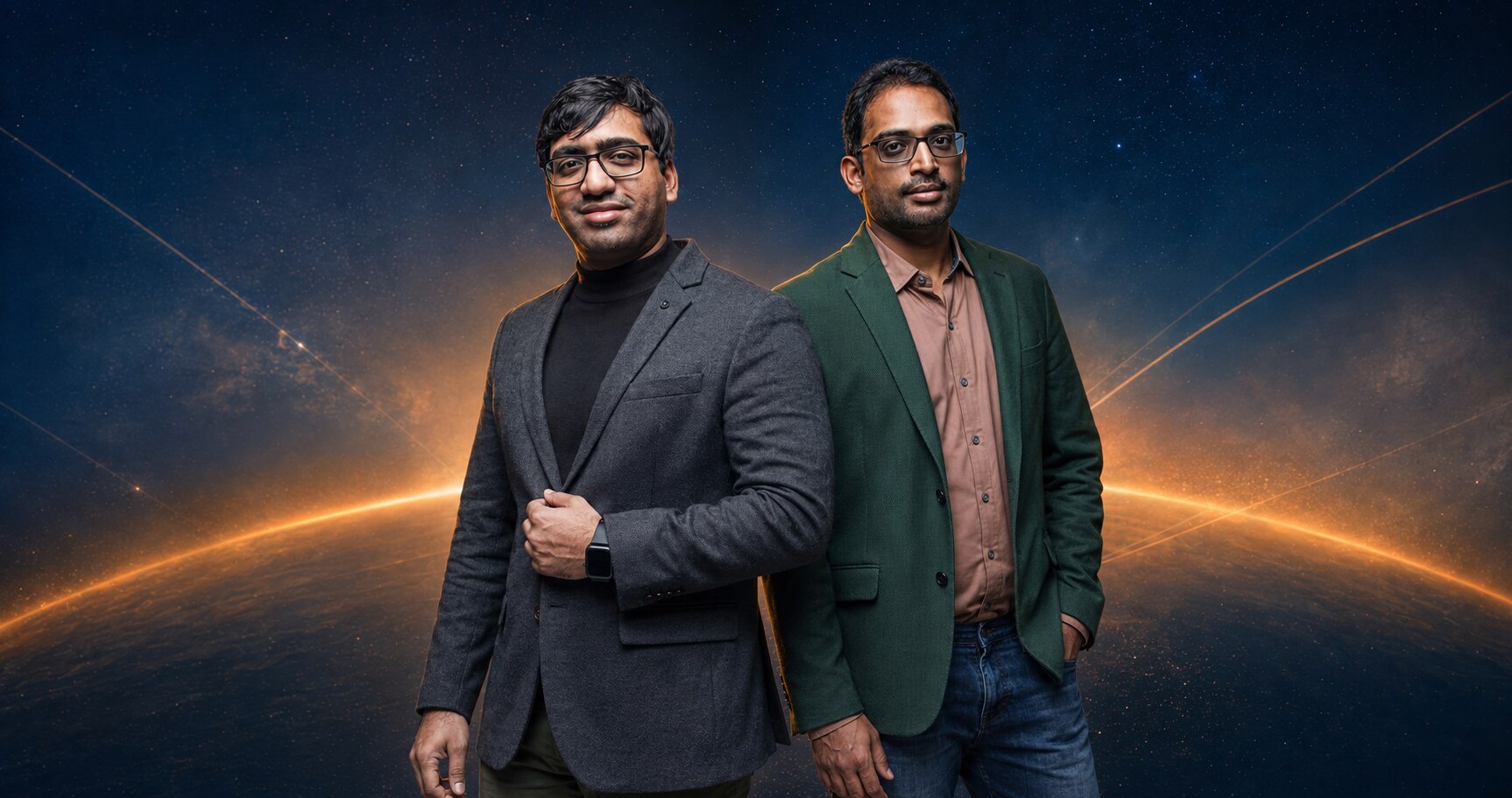
In 2018, Pawan Kumar Chandana, an IIT Kharagpur graduate who had spent six years working on ISRO's largest launch vehicle, the GSLV Mk III, and Naga Bharath Daka, an IIT Madras graduate who worked on avionics and flight-computer systems, resigned from one of the most respected and secure scientific institutions in India to start a rocket company. There was no Indian precedent for a private orbital launch firm, no regulatory pathway for one, no obvious customer, and no investor class accustomed to writing cheques for hardware that announces its failures on live television.
They did it in Hyderabad, and the choice of city was not incidental. Telangana had spent years assembling a deep-tech ecosystem: incubation and prototyping support through institutions such as T-Hub and T-Works, and beyond them a base of aerospace and defence manufacturers and precision-engineering suppliers. Skyroot's growth can be read in its addresses: first modest facilities, then MAX-Q, a 60,000-square-foot headquarters billed at its opening as the country's largest private rocket development facility under one roof, then the Infinity Campus, 200,000 square feet designed to build one orbital rocket a month.
Chandana and Daka leave ISRO to build India's first private orbital launch company.
IN-SPACe created as a single-window regulator; ISRO facilities formally open to private firms.
India's first privately built rocket reaches space on a suborbital flight, the first launch IN-SPACe ever authorised.
MAX-Q headquarters and the Infinity Campus come online; capacity of one orbital rocket a month.
$60M raised at a $1.1B valuation, co-led by GIC and Sherpalo; roughly $160M raised in total.
Vikram-1 reaches a 450 km orbit on its maiden flight and deploys every payload on schedule.
The State That Chose to Enable
Vikram-1 exists because the Indian state decided, in June 2020, to open its space sector to private enterprise, and then actually followed through. The reforms created IN-SPACe, a single-window agency that authorises and promotes private space activity, distinct from ISRO, which remains the nation's research and development agency, and from NewSpace India Limited, ISRO's commercial arm. These are not interchangeable bodies: ISRO builds knowledge, NSIL sells it, IN-SPACe referees and enables. Skyroot was among the first companies to gain formal access to ISRO's test facilities and expertise; on Saturday, its rocket flew from ISRO's own spaceport, supported by ISRO's range operations, tracked by systems the taxpayer built over half a century.
This was never a story of the private sector replacing ISRO. It is the story of ISRO's accumulated knowledge, infrastructure and people becoming the foundation on which a new generation of companies can build. Both founders are ISRO alumni; so is much of India's space startup workforce. India's space startup count has grown from one in 2014 to more than 400 today. That is what a well-designed reform looks like from the inside.
The Money and the Market
It is fashionable to treat Skyroot's unicorn valuation as a scoreboard. It is better understood as a measure of nerve. Rocket companies consume capital for years before earning revenue, cannot iterate cheaply, and fail in the most public way imaginable, in seconds, on camera. The fact that global and domestic investors, from GIC and Sherpalo to funds managed by BlackRock, held their positions through eight years of test stands and static fires says something encouraging about the maturing of Indian deep-tech finance. The unicorn label means only that investors believe; it does not mean customers have paid.
The market Skyroot is entering is real. The company argues that small-satellite launch is deeply constrained on the supply side even as demand for satellite services grows, and operators of small constellations increasingly want dedicated launches to precise orbits on their own schedules rather than spare room on a large rideshare mission. But the instructive comparison is Rocket Lab, not SpaceX: even after a successful first Electron flight, it took years to reach a reliable cadence. India's space economy is worth about $8.4 billion today; the government's stated ambition is $44 billion by 2033. No single company will deliver that. A dozen credible ones might.
Repeat flights arrive on schedule; the Infinity Campus hits one rocket a month; commercial customers sign for dedicated launches; Vikram-2 extends capacity; Hyderabad becomes a credible global small-launch hub alongside a maturing Indian supplier base.
Cadence slips, economics stay unproven, foreign employers court India's propulsion and avionics talent, insurance and export-control frameworks lag, and the maiden triumph remains an isolated demonstration rather than a business.
What Must Be Proven Next
One flawless flight is a demonstration, not a business. The market will judge Vikram-1 on repeatability, price per kilogramme, insurance-worthiness and schedule discipline, not on a single successful arrival. Skyroot itself says further test flights will precede routine commercial missions; that sequencing is wise, and observers should hold the company to it. A mature space power also asks harder questions on its good days: where the boundary lies between public infrastructure and private profit, whether India can retain the engineers a global launch industry will now court, and whether Indian regulation will lead on orbital debris or lag it. It is a fine irony that one of Vikram-1's first payloads was a robotic arm designed to capture space junk.
Late on Saturday, the Prime Minister called the launch a defining moment in India's space journey, and for once the official language undershot the reality. What was defined at 12.05 pm was not merely a company's capability but a country's method: public knowledge patiently built over sixty years, reforms that let it flow outward, a state that chose to enable rather than monopolise, a regional ecosystem that supplied the workshop, investors who supplied the patience, and two engineers who supplied the will.
"The rocket rose alone, as rockets must. Everything that lifted it was shared."
Inference Editorial